
Columbus Previous Residents by Era
One Columbus address can open several lines of history. The current Columbus parcel record comes first. It supplies a PPIN, PARID, deed book and page, and legal text. That legal text can outlast street renumbering in Columbus. Next, match the source to the era you need. The Columbus Chancery online land index reaches back only to February 2002. Earlier Columbus books may sit in the Historic Virtual Index. Others rest at the courthouse or a library archive. Directories, municipal minutes, maps, court indexes, and probate files add dated context. None of them is a complete occupancy list. Treat each as one clue among many in Columbus.
| Source | Years it covers | Where held | What it can show |
|---|---|---|---|
| Columbus Chancery online land index | February 2002 to present | Columbus Lowndes Chancery Clerk and official portal | Columbus recorded instruments, parties, book/page, and legal-property details |
| Columbus Historic Virtual Index | Older book/page material, start date not fully confirmed | Columbus Chancery portal and courthouse | Columbus historic index navigation and informational images |
| Columbus Library Circuit Court Index | 1829 to 1919 | Columbus Local History and Billups-Garth files | Columbus surname, case number, and a route to original files |
| Columbus Chancery Probate Index | 1830 to 1964 | Columbus Local History and Billups-Garth files | Estate, guardian, apprenticeship, and other named files |
| Columbus directories and city minutes | Confirmed directory points from 1873 to 1977; minutes 1839 to 1906 | Columbus Library, MDAH, MSU, and MDL | Dated Columbus names, addresses, businesses, and civic activity |
| Columbus Sanborn maps | 1885 and later located map years | Library of Congress and Columbus MDAH references | Columbus footprint, street, use, and block context |
A missing online result means little. The record may predate the portal. It may also fall in an index gap or sit under a different Columbus spelling, so log the source, the date, and the exact address form with every find.
Columbus Previous Residents Start With Parcels
The Columbus Lowndes appraisal and real-property forms accept PPIN, PARID, owner, and address, and results can add the deed book, deed page, and legal text. Save those Columbus fields. Note the effective year the portal shows. Owner is not occupancy. The mailing address, situs address, and legal description can each point somewhere different in Columbus. A tax amount proves no residency. Treat the exact parcel identifiers as bridges. The appraisal result opens the Chancery land index, and a property description can be matched against a historic book or map. Search one criterion at a time if the form clears other inputs. An unrecognized Columbus address is not a dead end. Keep the printed string. Then try a street-suffix variant, a prior number, or the legal description. Never merge Columbus sources into one supposed resident record.
The Columbus Lowndes appraisal search is the official starting point for these parcel fields. Date each result, because the portal is marked Effective Year 2026.
Columbus Previous Residents and Deeds
A Columbus address history lives in the deed chain. It is not in a roster of past residents. Each deed records who conveyed the property and to whom. Start at the Columbus assessor. Pull the PPIN, PARID, deed book and page, and the legal description. Then take those details to the Columbus Chancery search. The land portal accepts searches by party name, street and number, parcel or PPIN, legal description, subdivision, block and lot, section, township, range, and instrument type. Begin with the most recent Columbus instrument. Note its parties and property language. Follow the prior reference only when the description matches.
- Find the current Columbus parcel in the assessor search and preserve the PPIN, PARID, deed book/page, legal text, and capture date.
- Search the Columbus Chancery index with the parcel, address, legal description, or named party and open the matching instrument entry.
- Record the Columbus instrument type, recording date, book/page or instrument number, grantor, grantee, and property description.
- Use the earlier deed reference and the prior party names to locate the next Columbus transaction backward, checking the legal description at each step.
- When the online period ends, use the Historic Virtual Index's book and page route, then ask the Columbus Chancery Clerk about the courthouse index or an official copy.
- Build a dated Columbus event list and mark every unresolved jump rather than guessing that two same-name parties are the same person.
- Grantor
- The party conveying an interest in an instrument.
- Grantee
- The party receiving that interest in an instrument.
- Chain of title
- A linked sequence of property instruments traced through matching legal descriptions and references.
- Legal description
- The recorded land description, such as lot, block, subdivision, or survey terms, used to distinguish a parcel from a changing street label.
The Columbus official land-record portal labels its online index as informational, with the Columbus courthouse index controlling in any dispute. Images and official copies follow separate purchase rules.
Earlier Columbus Deed Books
The historic Columbus path sits outside the main online date range. In the Historic Virtual Index, find the relevant Columbus index entry first. Then use book or volume and page navigation to reach the official-record workflow. That Columbus system publishes no complete beginning year and no volume-by-volume coverage list. A failed search is an access question, not proof that no earlier conveyance exists.
The Lowndes Chancery Clerk sits at 505 2nd Ave N, Columbus. Hours run Monday through Friday, 8 to 5, and the phone is 662-329-5800. For coverage questions, official copies, or a book that will not resolve online, the official Columbus Chancery page helps. The courthouse index helps too, and both are the right channels. Portal purchases carry a 3.5 percent service fee with a $2 minimum. Fees are nonrefundable. Ask for the current Columbus copy price before ordering a longer run.
Note: An online image can guide a Columbus search. The Columbus courthouse record controls when an official copy is required.
Past Residents in Columbus Directories
Property records and household history move on separate tracks. For past residents of Columbus, the strongest printed leads are the 1873 local index, the 1918 MDAH Polk catalog entry, and the 1938 and 1977 volumes. Those later volumes are held at Mississippi State University. MDAH catalogs the 1918 item under call 917.62CD/Columbus/1918 in its Archival Reading Room. A volume with the right entry can yield a dated printed name, address, business, or role. Directory entries have limits, though. A listing may capture only a household head, business owner, telephone subscriber, boarder, or officeholder. It never names everyone at an address.
Work from address to household in a compact sequence. Start with a printed address and its year. Pull the directory page. Then pair it with a census or archival record that carries its own date. Finish with a map or minute-book check on the place itself. Keep the gaps between surviving years intact rather than smoothing them over. The Columbus city directory page lays out the full historical shelf. Consult it directly instead of relying on one search result.
Two library rooms deepen the resident lookup. The Buckley Genealogy Room holds more than 5,000 books and periodicals. It also offers nearly 1,000 reels of microfilm. The Billups-Garth Archival Room contains more than 1,000 cubic feet of original material. The Carl E. Brown collection adds photographs of houses, families, businesses, and churches. These were taken from the 1940s through the 1980s. The Lowndes local-history indexes describe circuit, chancery, vertical-file, photograph, and scrapbook collections. Those collections can anchor an address timeline in a local source.
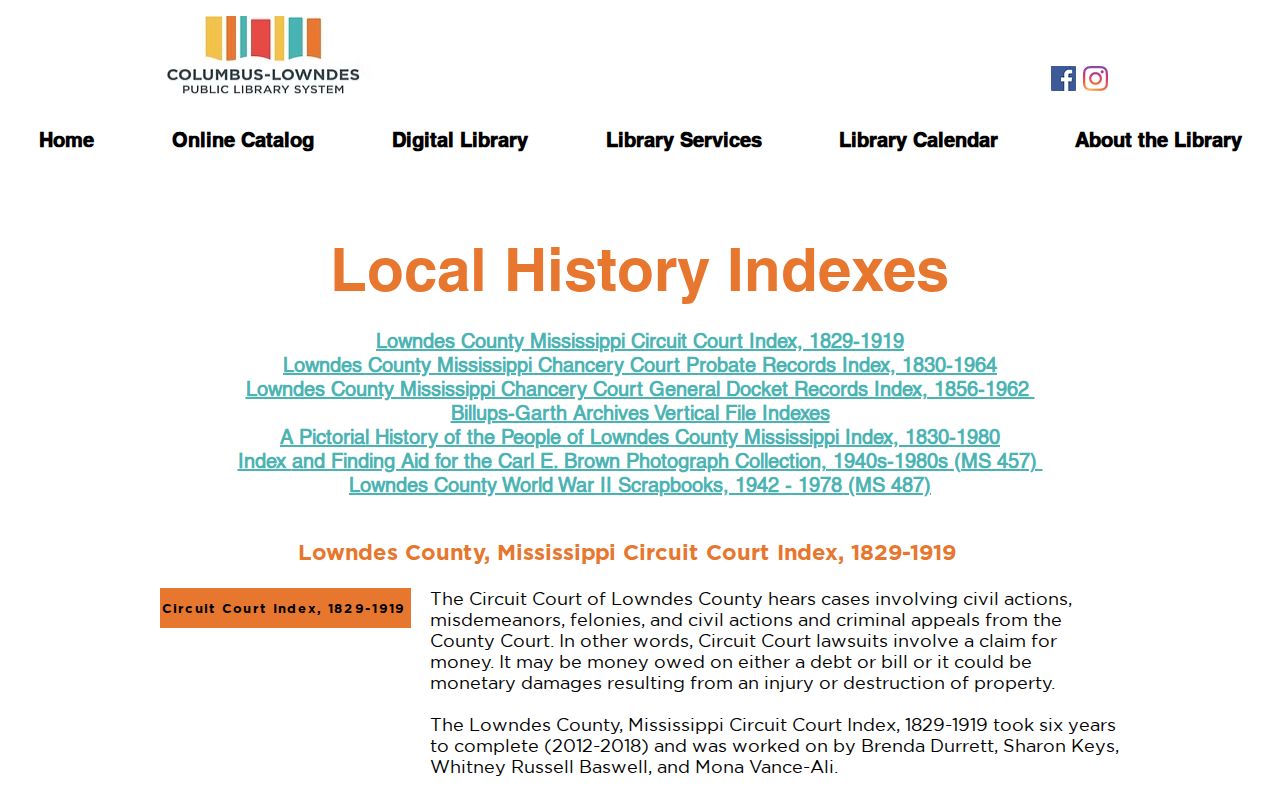
A historic name or property that never surfaces in an online land-record search still has a request path through these local indexes and their custodians.
Columbus Previous Residents on Maps
Sanborn maps check a physical place, not an occupant roster. The Library of Congress holds a seven-sheet Columbus set from 1885. MDAH materials point to later map years as well. These include 1886, 1891 to 1892, 1897, 1904, 1910, 1925, and 1946. Set the sheet date beside the directory or deed date. Then compare the street name, building footprint, and stated use. Numbers rarely tell the whole story at once. Before concluding anything, weigh a changed street label, a renumbering, a postal change, or a different parcel.
The Columbus City Minute Books cover 1839 to 1906 in the Mississippi Digital Library. They record civic actions, street improvements, and named businesses. A minute entry can date an event near a property. It cannot prove someone lived there. For map work, the 1885 Columbus Sanborn set is the documented starting point.
Columbus Previous Residents in Indexes
A deed trail sometimes stops cold. The cause may be an estate, a dispute, or an earlier owner name. When it does, the local indexes give you a focused follow-up. The Circuit Court Index spans 1829 to 1919 and searches by surname or case number. The Chancery Probate Records Index covers 1830 to 1964. It reaches estates, guardianships, apprenticeships, and other sensitive categories. The General Docket Index runs 1856 to 1962 and is alphabetical by plaintiff surname. It can surface title disputes, deeds, divorces, notes, and ex parte matters.
Bring Local History a surname, case number, address, parcel key, or date range. Ask for the index result or the original Billups-Garth file. A probate or court file may establish a relationship or a property interest. It is still not a residence record by itself. For any sensitive historical file, read the access limits and redactions with the custodian.
Columbus Address History Context
The record trail in this county reaches far past any modern portal. Lowndes County was organized in 1830. MDAH Series 2050 identifies selected court, land, assessor, and tax materials from the 1830s through 1879. The 1935 to 1942 WPA Historical Research Project is another organized lead. It covers Lowndes agriculture, Columbus correspondence and leaders, and other county topics. Sources like these explain a historical setting. They cannot fill missing deeds or directory years.
Local business references work as date checks too. The library's county-history material identifies Laws Drug Store, opened in 1905 and later associated with 221 Fifth Street South. It also names the OK Motor Company at 401 to 403 Second Avenue South in the circa-1930s period. Treat both strictly as historical address leads. Compare each one with a directory page or map before tying it to a parcel.
Note: A dated record can support a house-history event. It should never be rewritten as proof of a continuous household.
Columbus Previous Residents Request Path
When no online index reaches the era you need, fall back on the custodians. Ask the Chancery Clerk whether the book, page, or instrument can be checked at the courthouse. Ask, too, whether it can be supplied as an official copy. The Local History Department can pull an existing index, finding aid, or microfilm reel. It can also pull an original-file reference. MDAH offers archival access to its Lowndes record groups. The Mississippi Digital Library can identify digitized items. For a city addressing or permit question, request an existing file from the Building, Planning, or Community Development custodian. The city publishes no searchable permit or addressing database.
An agency-held record is sometimes the proper source. Send a narrow written request under the Mississippi Public Records Act of 1983. Name one record type, the address or parcel identifier, and a date range. Request a fee estimate. Ask the custodian to identify any withheld portion or applicable exemption.